Hernias are among the most common surgical conditions — and among the most misunderstood. Many patients are told to "watch and wait," or assume that because a hernia is not causing severe pain, it can be safely ignored. This guide sets out clearly what hernias are, which types carry the greatest risk, the warning signs that demand prompt assessment, and what modern surgery actually involves.
Mr Trif Papettas FRCS
Consultant Colorectal & General Surgeon at Nuffield Health Warwickshire — introducing himself, his practice, and his approach to hernia surgery.
1,000+ hernia repairs · Robotic, laparoscopic & open · Exclusively Warwickshire-based
Before choosing your surgeon: our dedicated guide at herniasurgeonwarwickshire.co.uk covers the questions every patient should ask — including how to interpret audit data and why surgeon volume matters.
How to Choose a Hernia SurgeonTypes of hernia — a surgeon's guide
A hernia occurs when internal tissue — usually fat, bowel, or other abdominal contents — pushes through a weakness in the surrounding muscle wall. Each hernia type has its own anatomy, risk profile, and preferred surgical approach. Understanding the differences helps patients ask the right questions and make informed decisions about treatment.
Inguinal Hernia
Most common · Predominantly men · ~70% of all herniasThe most frequent hernia, arising in the inguinal canal — a narrow passage in the lower abdominal wall through which the spermatic cord passes in men. Tissue (usually fat or a loop of bowel) pushes through this inherent weakness, producing a visible or palpable lump in the groin. The lump is typically more prominent on standing or straining, and may reduce on lying down.
Men are affected far more commonly due to the anatomical passage created by testicular descent during development. Women can develop inguinal hernias but less frequently. The condition rarely resolves spontaneously and typically enlarges over time.
Strangulation risk if longstanding or enlarging
Blausen Medical Communications, CC BY 3.0, Wikimedia Commons
Femoral Hernia
Higher risk · More common in women · Requires prompt repairFemoral hernias protrude through the femoral canal — a small passage at the top of the inner thigh, just below and medial to the inguinal ligament, adjacent to the femoral artery and vein. The canal is characteristically narrow, giving the hernia little room to enlarge before its contents become compressed — making femoral hernias significantly more prone to strangulation than inguinal hernias.
They are more common in women, particularly following childbirth. The lump appears below the groin crease at the inner thigh. Because of the high strangulation risk, prompt surgical repair is recommended once a femoral hernia is diagnosed, even if minimally symptomatic.
High strangulation risk — early repair strongly advised
National Institutes of Health (NIH), public domain, Wikimedia Commons
Umbilical Hernia
Adults and children · Common · Often painless initiallyAn umbilical hernia protrudes through a weakness at or near the navel — exploiting the natural defect in the abdominal wall left by the umbilical cord. In adults, the hernia typically contains omentum (fat) or occasionally a loop of bowel. Umbilical hernias range from a small, barely noticeable swelling to a large, prominent bulge.
Many are painless, but they tend to enlarge progressively over time. Repair is generally recommended once the hernia becomes symptomatic, enlarging, or difficult to reduce, as spontaneous resolution in adults is rare. Open suture repair is appropriate for small defects; laparoscopic or open mesh repair is preferred for larger umbilical hernias to reduce recurrence.
Enlarges over time — repair when symptomatic
Wikimedia Commons
Incisional Hernia
Following previous abdominal surgery · Can be large and complexAn incisional hernia develops through the site of a previous surgical wound, where the abdominal wall has been weakened by the original incision and any subsequent healing. They are particularly common after laparotomy (large open abdominal operations) and occur in approximately 10–15% of all abdominal surgical wounds. Risk is increased by wound infection, obesity, smoking, and poor nutritional status at the time of the original surgery.
Incisional hernias tend to enlarge progressively. Repair is technically more demanding than primary hernia repair — the anatomy is distorted by scarring and the defect is often wide. Robotic and laparoscopic techniques with mesh offer the best long-term outcomes in experienced hands, with lower wound complication rates and shorter recovery than open repair.
Specialist assessment — often complex repair required
Blausen Medical Communications, CC BY 3.0, Wikimedia Commons
Sports Hernia (Athletic Pubalgia)
Active adults · Men predominantly · No visible bulgeA sports hernia — more precisely termed athletic pubalgia — is a tear or weakness of the soft tissues in the groin without a visible hernial protrusion. It involves disruption of the posterior inguinal wall, adductor muscle insertions, or abdominal wall attachments at the pubis. The absence of a visible lump frequently delays diagnosis, as the condition is often mistaken for a muscle strain.
The hallmark symptom is chronic, deep groin pain — typically worsened by sprinting, cutting movements, and coughing. MRI is essential to characterise the lesion. A modified laparoscopic technique addresses the posterior wall deficiency with mesh reinforcement, and return-to-sport outcomes in experienced hands are excellent.
Specialist diagnosis required · MRI essential
National Institutes of Health (NIH), public domain, Wikimedia Commons
Recurrent & Complex Hernia
Following previous repair · Technically demanding · Robotic technique preferredA hernia that returns following a prior surgical repair presents particular technical challenges. The anatomy is distorted by the original operation and any mesh that was placed — critical structures are less predictable in their position, and dissection planes are obliterated by scar tissue. Recurrence rates nationally are approximately 1–3% after laparoscopic repair and 5–10% after open primary repair.
Complex hernias — whether recurrent, bilateral, or involving contaminated fields — require surgeons with high volume experience and familiarity with the full range of technical approaches. Robotic surgery offers enhanced three-dimensional visualisation, precise instrument articulation, and improved dexterity in the confined, scarred operative field — advantages that are particularly meaningful in recurrent cases. Mr Papettas offers robotic-assisted repair for complex and recurrent hernias at Nuffield Health Warwickshire.
Specialist repair — do not return to original surgeon if recurrence is suspected
Wikimedia Commons
Warning signs — when a hernia becomes a surgical emergency
The majority of hernias are elective surgical problems — they can be planned and repaired in a controlled setting. However, two serious complications can transform a routine hernia into a life-threatening emergency. Understanding these warning signs could save your life.
Go to A&E immediately if your hernia develops any of the following
- The hernia suddenly cannot be pushed back in when you lie down — it has become irreducible
- Severe, sudden-onset pain at the site of the hernia — particularly if previously it caused only mild discomfort
- The hernia becomes hard, tender, and discoloured — the overlying skin turns red, purple, or dark
- Nausea, vomiting, and inability to pass wind or open the bowels — suggesting bowel obstruction
- Fever and systemic illness in association with hernia pain — suggesting infection or ischaemia
These symptoms suggest strangulation — the blood supply to the contents of the hernia has been compromised. Without urgent surgery, the herniated tissue will die (infarct), leading to perforation, peritonitis, and potentially fatal sepsis. Do not wait to see your GP. Go directly to A&E.
Incarceration
The hernial contents become stuck outside the abdominal wall and cannot be reduced manually. Not immediately life-threatening but requires urgent surgical assessment — incarceration frequently precedes strangulation within hours.
Strangulation
The blood supply to the herniated tissue is cut off. This is a true surgical emergency requiring immediate operation. Delay measured in hours significantly increases mortality risk and the likelihood of bowel resection being required.
Obstruction
Bowel caught within the hernia becomes obstructed — causing abdominal distension, persistent vomiting, and cessation of bowel movements. Requires prompt surgical intervention to decompress and repair.
Richter's Hernia
Only part of the bowel wall is trapped in the hernia — complete obstruction may not occur, masking the severity. Strangulation can develop despite apparently mild symptoms. More common in femoral hernias. A high index of suspicion is required.
The case for elective repair: emergency hernia surgery carries 5–10× higher complication rates and significantly elevated mortality compared to planned elective repair. A hernia that is visible, symptomatic, or enlarging should be repaired electively — before complications develop. This is not a counsel of urgency but of prudence.
Surgical treatment — what are the options?
All hernias causing symptoms or carrying a risk of complications require surgical repair. There is no effective non-surgical treatment — trusses and support garments do not repair the underlying defect and may delay definitive management. The choice of technique is determined by the hernia's type, size, location, previous surgery, and the patient's fitness and anatomy.
| Technique | Approach | Best indicated for | Recovery |
|---|---|---|---|
| Laparoscopic repair Gold standard | TEP (totally extraperitoneal) or TAPP (transabdominal preperitoneal) — keyhole mesh repair with no or minimal entry into the peritoneal cavity | Inguinal hernias, bilateral repairs, sports hernia, most recurrent inguinal hernias | 1–2 weeks |
| Robotic-Assisted Available here | Keyhole with robotic precision — 3D vision, wristed instruments, tremor filtration | Complex, recurrent, large incisional hernias; reoperative field | 1–3 weeks |
| Laparoscopic IPOM | Intraperitoneal onlay mesh — keyhole placement of mesh over the defect from inside | Incisional, umbilical, epigastric hernias | 2–3 weeks |
| Open Lichtenstein Repair | Single groin incision, tension-free mesh reinforcement under direct vision | Inguinal hernias — patients unsuitable for GA, large or irreducible hernias | 3–5 weeks |
| Open Suture Repair | Direct tissue approximation without prosthetic mesh | Small umbilical or epigastric hernias; contaminated or infected fields | 3–4 weeks |
Watch: surgical techniques
Laparoscopic, robotic and open repair — see what each involves

Laparoscopic TEP inguinal hernia repair — 3D animated guide
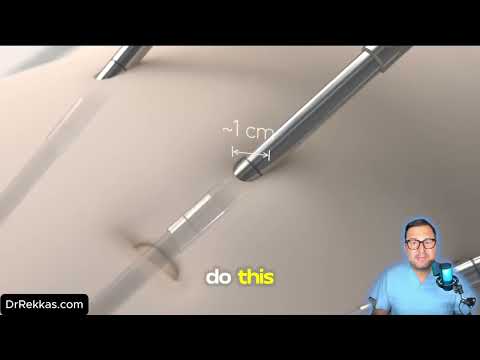
Robotic inguinal hernia repair — step-by-step narrated procedure
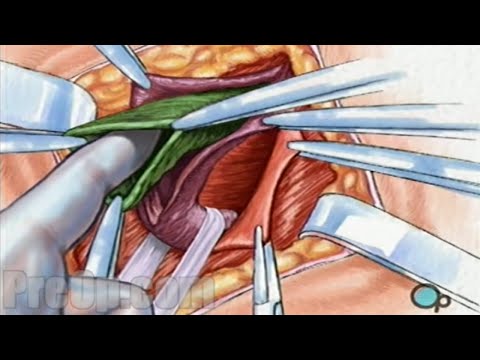
Open hernia repair — patient education and surgical guide
Available at Nuffield Health Warwickshire
Robotic-assisted hernia repair
Robotic surgery offers particular advantages in complex hernia cases — recurrent hernias, large incisional defects, and reoperative fields where previous scarring makes standard laparoscopic instruments less effective. The da Vinci robotic platform provides three-dimensional magnified vision, fully wristed instrument articulation, and complete elimination of surgical tremor — allowing precise dissection in anatomically challenging territory.
Mr Papettas performs robotic-assisted hernia and abdominal wall repair at Nuffield Health Warwickshire as part of an actively developing programme. This capability is available at only a small number of private centres in the Midlands.
Mesh in hernia repair — the evidence and the concerns
Surgical mesh has attracted significant media attention following well-publicised complications associated with transvaginal pelvic mesh. It is important to understand clearly that the mesh used in abdominal wall and groin hernia repair is fundamentally different in material, design, placement technique, and complication profile from the transvaginal mesh associated with those complications. The two should not be conflated.
The evidence for mesh in groin hernia repair is unambiguous: recurrence rates are approximately 1–3% with mesh reinforcement compared to 10–15% with suture-only repair. In incisional hernia, mesh repair reduces recurrence from around 40–50% (suture repair) to less than 10%. These are substantial, meaningful differences that justify mesh use in the vast majority of cases.
Mesh — what patients should know before surgery
- Mesh used in abdominal wall hernia repair is entirely distinct from pelvic mesh — the materials, indications, and complication profiles are not comparable
- Laparoscopically placed mesh has significantly lower rates of chronic groin pain than open mesh repair — an important reason to choose keyhole technique
- Modern lightweight polypropylene meshes are well-tolerated and integrate into the abdominal wall over 6–8 weeks
- Long-term complications (chronic pain, infection, migration) are uncommon and are minimised by appropriate technique and mesh selection
- Mesh-free repair is appropriate for small umbilical and epigastric hernias, and in contaminated fields — your surgeon will advise
- Mr Papettas discusses mesh use, alternatives, and individual risk at every hernia consultation
What to expect — recovery from hernia surgery
Elective laparoscopic hernia repair is a day-case procedure in the majority of patients. You are admitted on the morning of surgery, and for uncomplicated inguinal hernia repair the operation takes 30–60 minutes. Most patients go home within 2–3 hours of the procedure once recovery from the anaesthetic is complete.
Typical recovery milestones
- Days 1–3: Mild port-site discomfort manageable with simple analgesia (paracetamol, ibuprofen). Light walking is encouraged from day one — prolonged sitting or lying still is not advised.
- Days 5–10: Return to driving when comfortable and able to perform an emergency stop. This is typically 5–7 days after laparoscopic repair. Desk-based work is usually possible within 3–5 days.
- Weeks 2–4: Return to most physical activities. Avoid heavy lifting (above 10kg) for 4 weeks post-laparoscopic repair.
- 6 weeks+: Full return to strenuous sport, manual labour, and gym in most cases. Sports hernia patients typically return to competition at 6–10 weeks.
"Most patients are genuinely surprised by how comfortable recovery from laparoscopic hernia repair is. The majority are back to normal life within 10–14 days — a stark contrast to the 6-week recovery associated with traditional open surgery."
Optimising your outcome before surgery
Several modifiable factors significantly influence hernia repair outcomes. Smoking increases wound complication rates, mesh infection risk, and hernia recurrence — smoking cessation is strongly recommended in the weeks before elective repair. Obesity increases technical complexity and recurrence risk, particularly for large incisional hernias; meaningful weight loss before repair improves outcomes. Nutritional optimisation is important in patients with large hernias or previous wound problems.
Choosing the right surgeon for your hernia is as important as choosing the right technique. Our guide at herniasurgeonwarwickshire.co.uk provides the questions you should ask at every hernia consultation.
How to Choose a Hernia SurgeonSelf-referrals welcome. No GP letter required. Appointments at Nuffield Health Warwickshire, Leamington Spa.
This article is written for general information and does not constitute individual medical advice. Treatment should always follow clinical assessment by a qualified surgeon. All outcomes data reflect the author's own audited practice benchmarked against published national data.